AI Dispatch ·
AI Cements its Role Worldwide
The global race to automate is no longer theoretical but rather operational.
The global race to automate is no longer theoretical but rather operational.
Hi, I’m Lily. I live in the world of distribution, where the global race to automate is no longer theoretical but rather operational. In China, so-called ghost warehouses staffed entirely by AI-driven robots are operating nonstop without a single human on the floor. Such sensational progress creates a huge job-shift narrative, freeing and redirecting people toward higher-value work that truly requires human judgment.
The U.S. is moving fast as well. This week, roofing distribution’s Big 3 (SRS, QXO, and ABC Supply) are embedding AI across pricing, inventory, and sales. Washington launched Pax Silica, a nine-nation alliance to secure AI and critical tech supply chains. And market projections show AI in logistics growing nearly tenfold by 2034.
AI adoption in distribution is widespread, accelerating, and those still on the sidelines are already behind. This week, I’m sharing six stories that make the case.

AI is reshaping roofing distribution. Major players like SRS Distribution, QXO, and ABC Supply are deploying AI across pricing, inventory, and sales, with SRS now processing nearly half of residential shingle orders digitally; QXO uncovering $200 million in pricing losses; and independents pooling resources to keep pace.
ASCM’s 2026 Top 10 Supply Chain Trends report positions AI as the foundational “connective tissue” of modern supply chains. Key use cases include demand forecasting, dynamic freight routing, and predictive maintenance. The report also highlights geopolitical realignment, with companies shifting toward regional sourcing hubs in Mexico, Vietnam, and Eastern Europe. ASCM advises building strong data foundations and prioritizing AI literacy across teams. For distributors, this is a practitioner-built roadmap signaling where the industry is heading.
Roofing distributors are accelerating AI adoption across sales, pricing, and inventory. SRS Distribution now processes nearly one in two residential shingle orders digitally and launches three to five AI features monthly. QXO uncovered $200 million in pricing leakage at Beacon Roofing and is using AI to deliver double-digit productivity gains. ABC Supply has spent eight years building AI into fleet and inventory management. Independents are pooling resources to keep pace. As one analyst put it: “AI is no longer optional. Distributors who fail to adopt it risk falling behind.”
Amazon cut energy use by nearly 15% at three grocery fulfillment centers using Trane Technologies’ BrainBox AI, which autonomously adjusts temperature and ventilation systems. Following the pilot, Amazon will deploy the platform across 30+ U.S. grocery fulfillment and distribution sites, with in-store rollout planned for 2026. The company is targeting carbon neutrality by 2040. For distributors managing temperature-sensitive inventory, AI-driven climate control offers a plausible path to cut costs while meeting sustainability goals.
Celonis executives predict 2026 will mark a shift to context-aware systems built on “living digital twins” that reflect real-time operations. The focus moves from automating tasks to orchestrating outcomes, coordinating AI, people, and systems across entire workflows. Supply chains will serve as test beds, with AI rerouting shipments, rebalancing inventory, and coordinating suppliers dynamically. Celonis also expects open, interoperable platforms to replace vendor lock-in. For distributors, the message is clear: AI value depends on operational context, not standalone tools.
The AI in logistics and supply chain market is projected to grow from $20.1 billion to over $196.58 billion by 2034, according to Global Market Insights’ latest study. Machine learning holds 47% of the market; software leads at 56%. The U.S. dominates with 85% share, driven by early adoption in route optimization and warehouse automation. Growth is fueled by the need for real-time visibility and e-commerce expansion. Distributors watching from the sidelines should note: the market is pricing in widespread adoption, not experimentation.
The U.S. launched Pax Silica, a strategic alliance with Japan, South Korea, the UK, and five other partners to secure AI and critical technology supply chains. The initiative spans the full tech stack, from software to logistics infrastructure, aiming to reduce vulnerabilities and coordinate policy across member economies. Distributors not tracking government-led supply chain initiatives risk being caught off guard when similar policies reshape their own sector.
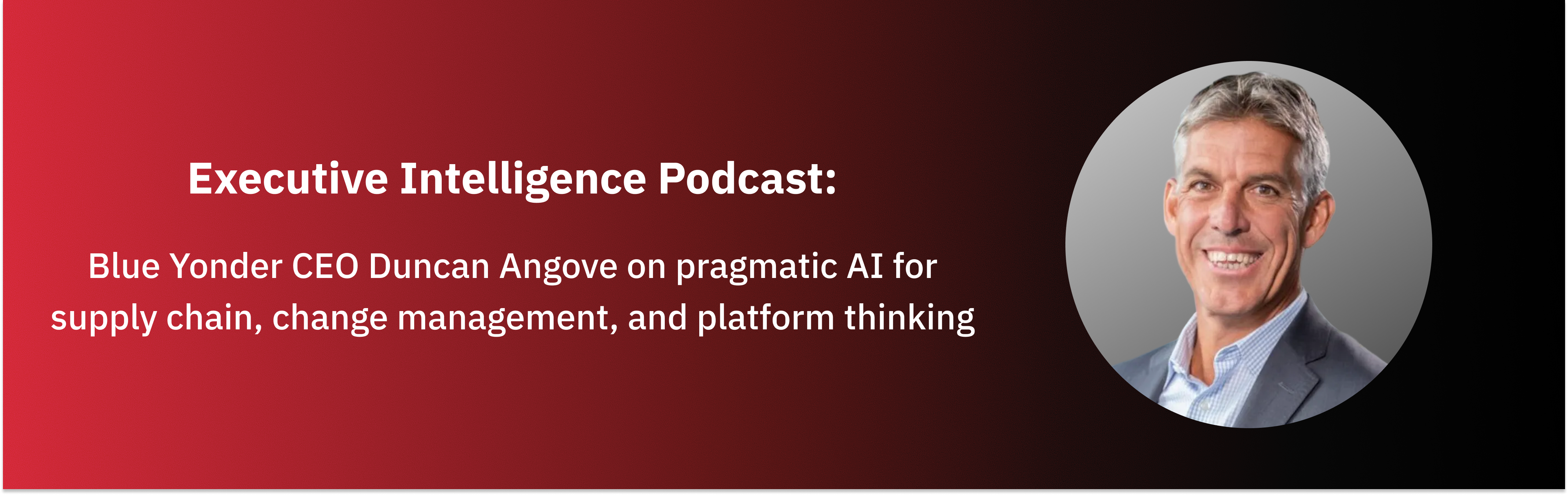
In this episode of diginomica’s Executive Intelligence, Blue Yonder CEO Duncan Angove discusses the company’s $2.5 billion R&D transformation to an end-to-end supply chain platform. Angove takes a pragmatic stance on AI, emphasizing precision, undoubtedly because AI mistakes in operations are expensive. His focus: using AI to remove mundane work and elevate human roles. Topics worth a listen include change management challenges and why supply chain leaders should demand purpose-built systems with real operational context.
AI has cemented its role as the binding layer of modern supply chains. Roofing’s Big 3 are deploying it at scale. Amazon is using it to cut emissions. Celonis says context-aware systems will define 2026. And the market is projected to approach $200 billion within a decade. As Blue Yonder CEO Duncan Angove puts it, the winners will be those using AI pragmatically: purpose-built, not gimmick-driven.