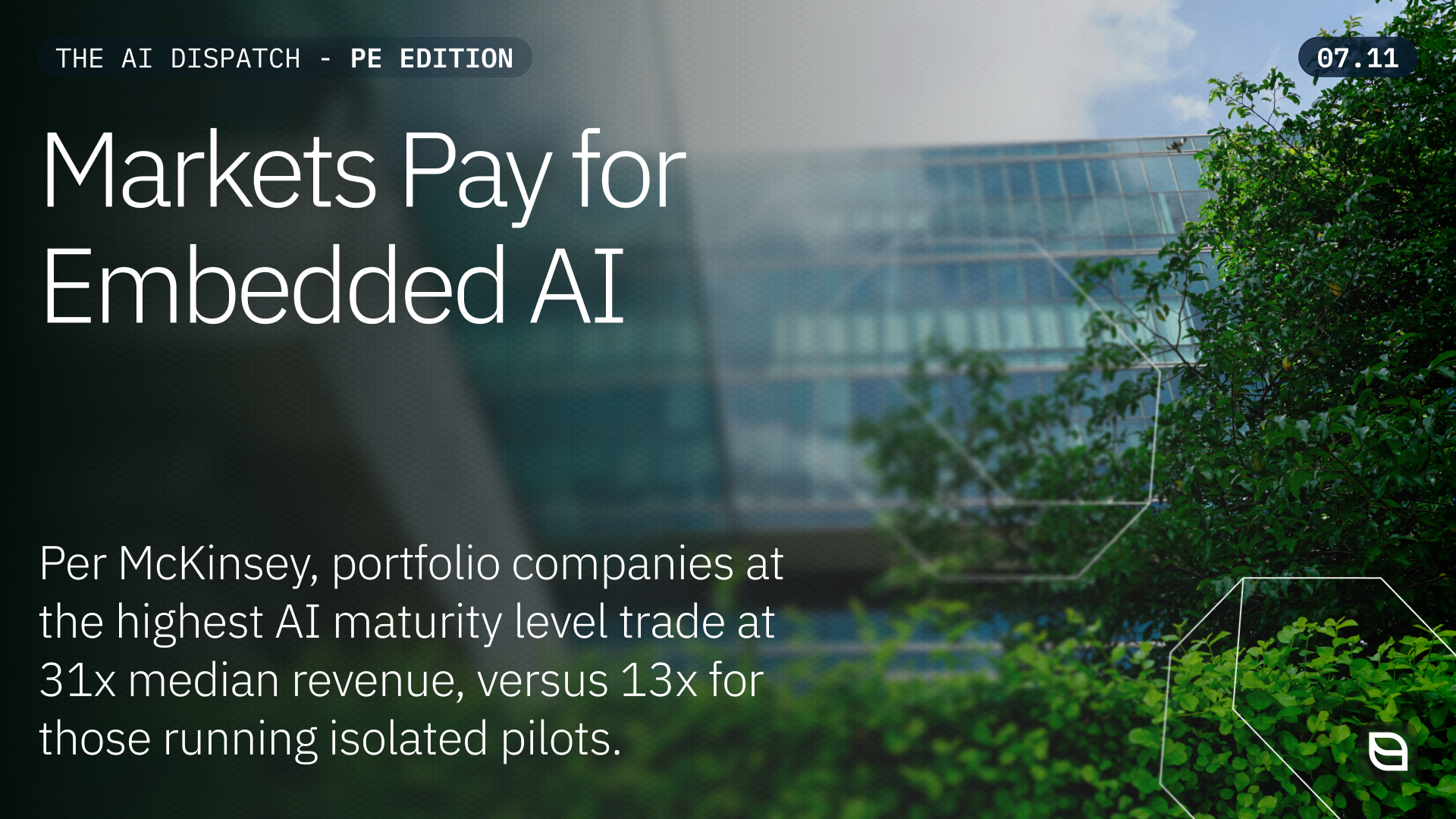
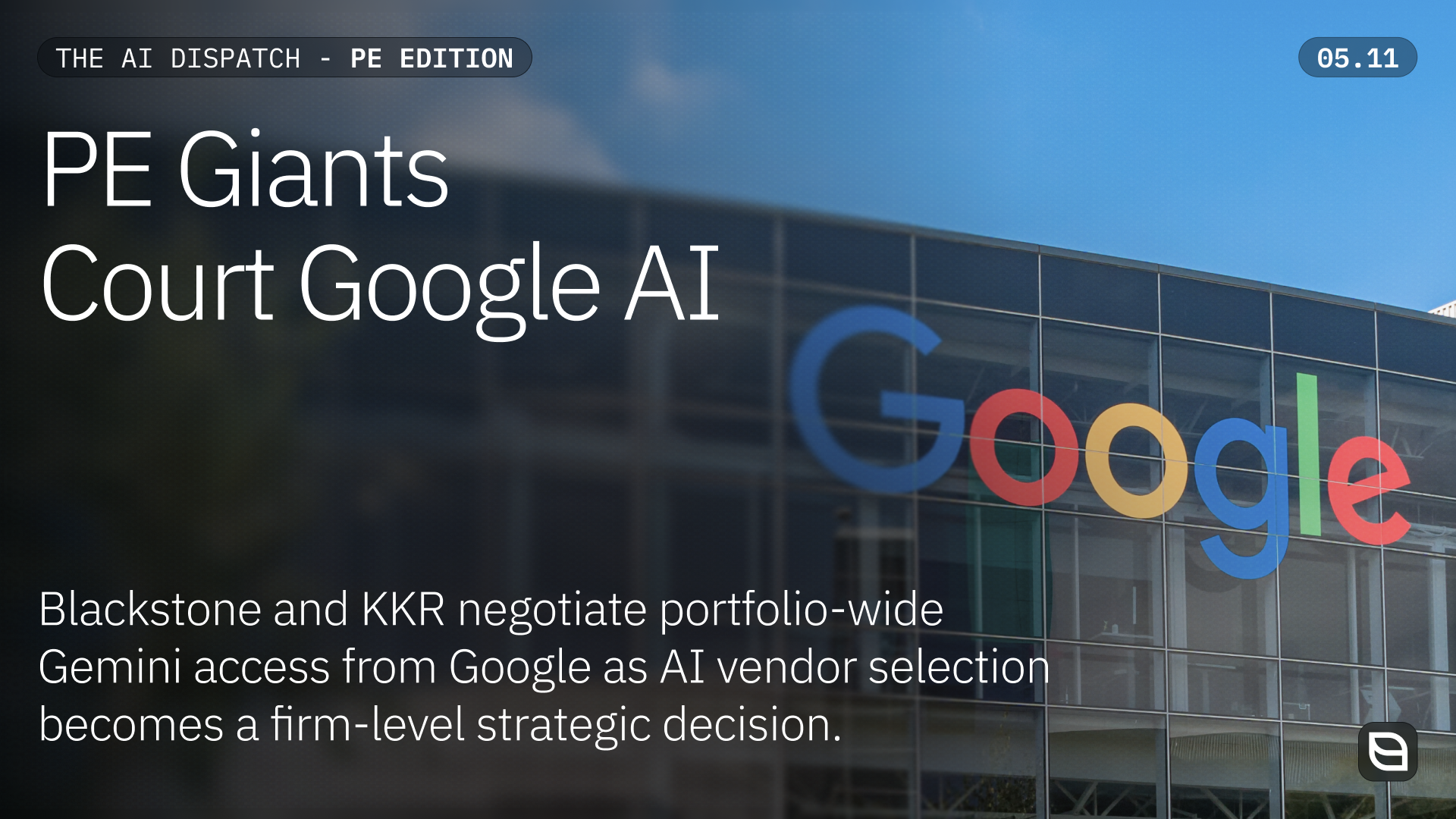
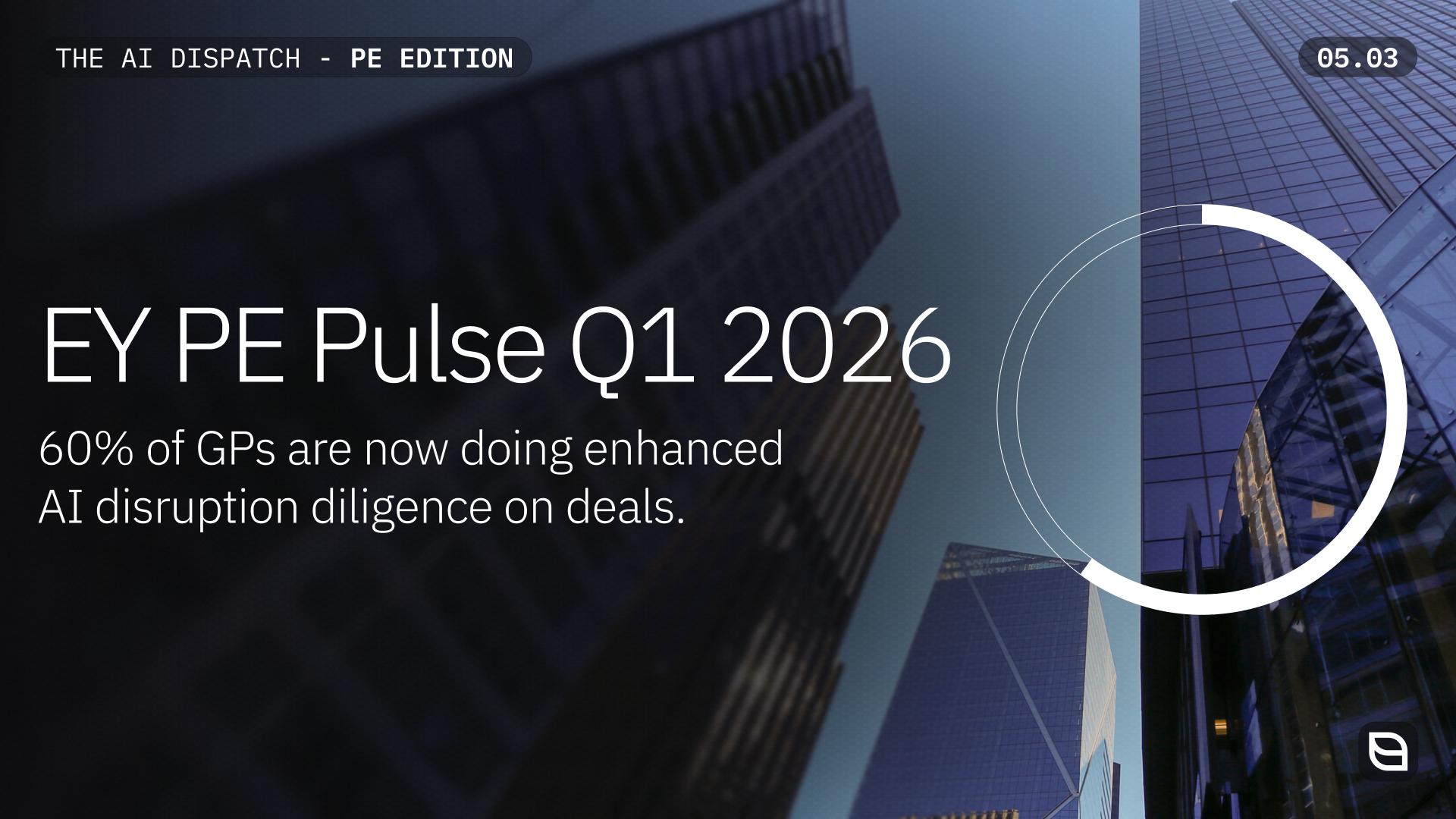
Private Equity Edition ·
PE Portfolios Accelerate AI Adoption
As public companies declined by nearly half (from 6,639 to 3,550) since 2000, PE-owned companies surged from 1,950 in 2000 to 14,300 in 2024.
As public companies declined by nearly half (from 6,639 to 3,550) since 2000, PE-owned companies surged from 1,950 in 2000 to 14,300 in 2024.
Hi, I’m Lily. I created this PE edition of the AI Dispatch for our growing community of thousands of private equity leaders and portfolio company operators navigating AI implementation.
This week’s theme: Private equity funds become AI’s dominant distribution channel.
As public companies declined by nearly half (from 6,639 to 3,550) since 2000, PE-owned companies surged from 1,950 in 2000 to 14,300 in 2024. This scale, combined with PE’s mandate to quickly create value, makes portfolios the perfect proving ground for AI startups.
For both sides, the advantage is clear: AI vendors prove their worth in one portfolio company, then PE funds push deployment across 20+ sister companies in months, turning AI into a multiplier.
In this dispatch, we examine how portfolio networks accelerate AI deployment, why LPs care about GP adoption rates, and how Univar (Apollo’s portco) deployed AI across three operational layers.
Tomasz Tunguz reveals PE portfolios now comprise 14,300 companies (a 4:1 ratio vs. public firms), creating the dominant distribution channel for AI startups. Portfolio companies’ mid-market profile (<500 employees, 7.0% revenue growth) enables faster AI deployment cycles. The distribution model works because PE firms control networks of 20-50 companies. An AI startup can prove value in one portco, then get introduced to sister companies immediately, bypassing the traditional enterprise sales cycle of cold outreach, multiple stakeholders, and 12-month deal cycles. Read more →
Private Equity International’s LP Perspectives 2026 Study reveals that LPs are tracking how GPs deploy AI across portfolios, with 47% monitoring adoption closely, while 43% being aware but not actively tracking it. Only 10% ignore AI adoption entirely. AI has emerged as the fourth-most cited factor impacting performance over the next 12 months (29%, up from 14% a year ago). At the portfolio level, AI ranks as a top-three value creation lever for companies with heavy manual processing, though fit does vary by business model. The implication for GPs: LPs are explicitly asking “Where does AI create measurable value in your portfolio?” Generic AI strategies won’t satisfy LP due diligence; operators need specific use cases with proven ROI. Read more →
Cambrex, a Permira portfolio company in pharmaceutical manufacturing, deployed an AI agent that continuously monitors competitive intelligence sources: FDA filings, NIH databases, industry news, and internal proprietary data. Leadership now stays informed without manual research, while sales teams can access on-demand competitor intel before customer calls. By Q4 2025, the agent will answer complex questions combining internal and external data in seconds. This demonstrates how portfolio companies can automate competitive intelligence that previously required dedicated analyst teams. Read more →
Every week, we’ll bring you a new, real-world example of how targeted AI deployments within portfolios are solving persistent business challenges.
Company: Univar Solutions (Apollo Global Management portfolio company), the world’s third-largest chemical distributor managing facilities across North America, Europe, and Latin America.
Univar faced compounding operational redundancies and bottlenecks across three critical areas:
Reactive demand forecasting during weather chaos
Lone worker safety gaps in operations with hazardous chemicals
Fragmented eCommerce search due to inconsistent units
To solve those, Univar deployed a three-layer AI stack between 2023-2025:
Challenge: Demand forecasting was reactive, leaving the company scrambling during weather disruptions like 2021’s Texas polar storm and Hurricane Ida.
Solution: Predictive Demand Forecasting AI Algorithm (2023). It analyzes weather patterns and ordering deviations to predict demand spikes before disruptions occur.
Results:
Precise predictions of demand peaks from natural events or overproduction
Real-time notifications when customers deviate from ordering patterns
Challenge: Lone workers were handling hazardous chemicals at 2 AM on tanker tops or offloading rail cars 150 feet from help centers, facing life-threatening safety risks.
Solution: Samsara AI Safety Platform with Wearables (2024-2025). Wearable devices with year-long battery life, forward-facing AI-powered dash cameras, and panic buttons protect workers handling chemicals that “can go boom, can burn, and can hurt.”
Results:
Real-time alerts when lone workers need assistance in remote locations
40% reduction in overall incident rates across private fleet
Challenge: eCommerce search yielded poor results as customers struggled to find the right chemical products due to inconsistent inventory terms (”24 inches” vs “24 in” vs “2 feet”).
Solution: HawkSearch AI for eCommerce (Ongoing). A smart search with AI agents, natural language processing for shopper questions, and automated standardization of search terms.
Results:
23% increase in average order value
20% increase in site conversions
66% increase in monthly search sessions
28% decrease in search exits
3x faster indexing speed
Why This Worked: Apollo-backed Univar didn’t chase AI mindlessly; they deployed purpose-built AI for three distinct operational pain points. Each AI layer addressed a long-term business problem, and while not integrated simultaneously, together they compounded operational efficiency across Univar’s supply chain.
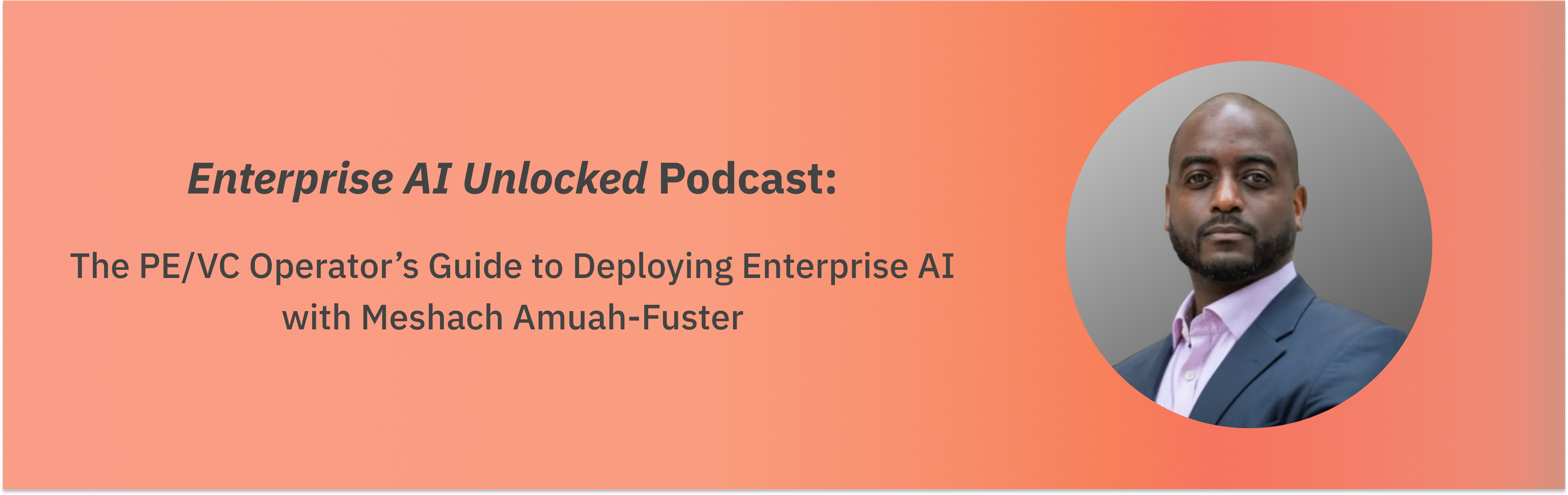
In this episode of Enterprise AI Unlocked, Meshach Amuah-Fuster, serial CEO who has deployed AI across Vimeo, Kayako, and ESW Capital’s 12-company portfolio stack, breaks down frameworks for AI deployment when board accountability is real. His Use Case Matrix prioritizes AI initiatives by value proposition, customer understanding, and time to value: remove one element and initiatives collapse. Key insight: “You wouldn’t have a sales team without a CRM. Why would you use disparate AI systems across a large organization without a tool that can monitor everything at once?” Watch/Listen here →
While the Univar story shows tactical execution, Tunguz’s data reveals that PE portcos have become the infrastructure through which AI gets validated and distributed.
I’m seeing this pattern accelerate in conversations with portfolio operators: If you’re a GP, your portfolio is now an AI distribution network, whether you recognize it or not. AI startups are targeting your companies because proving value in one creates immediate cross-sell opportunities across sister companies. If you’re a portfolio operator, your AI deployment isn’t just about your business; it’s proof-of-concept for the entire portfolio. Univar’s demand forecasting success could expedite deployment at other Apollo distribution companies. But only if the learning gets shared.
The question for your next board meeting: “Which AI deployments in our portfolio should we be replicating across sister companies?” Because if you’re solving it alone, you’re missing the network advantage that makes PE portfolios the fastest channel in the market.
January 26 - 27, 2026 | Riyadh
The GCC’s premier private capital gathering connects 1,000+ senior investors including 300+ LPs (Mubadala, PIF, KfW Capital) and 600+ GPs (Apollo, CVC Capital Partners). The event features 80+ speakers covering PE, private credit, VC, infrastructure, and real estate, plus LP-led sessions and curated networking. Free places for qualifying LPs. [Register here →]
February 22 - 25, 2026 | JW Marriott Orlando, Grande Lakes
A premier gathering uniting PE leaders with active LP allocators through an LP Council, investor-only dinners, and pre-arranged meetings. Focus areas: navigating geopolitical fundraising turbulence, portfolio value creation, and raising capital in compressed timelines. Features curated introductions and swap sessions on fund tactics. [Register here →]