Private Equity Edition ·
PE's 2025 AI Reckoning
AI adoption in private equity is accelerating at the portfolio level, but most firms are still catching up internally.
AI adoption in private equity is accelerating at the portfolio level, but most firms are still catching up internally.
Hi, I’m Lily. I created this PE edition of the AI Dispatch for our growing community of thousands of private equity leaders and portfolio company operators navigating AI implementation.
This week’s theme: Where PE's AI ambitions met portfolio reality in 2025.
AI adoption in private equity is accelerating at the portfolio level, but most firms are still catching up internally. Only 7% of GPs use AI extensively, yet half of mid-market portcos in Morgan Stanley's PE funds have active initiatives. The gap is closing fast, and 2026 will reward firms that move from "exploring" to operationalizing. In this final edition of the year, we're looking at the benchmarks, the infrastructure plays, and a Permira portco showing that 4.6 billion tickets can run on AI when built with care, and that’s the 2025's hard work magic in action!
PitchBook reports that, per Dynamo Software's 2025 survey of ~100 LPs and GPs, only 7% used AI extensively, 29% have incorporated it into some processes, and 59% were still exploring. PitchBook urges fund managers to embed vetted AI partners across portfolios and digitize data at the beginning of 2026. With 86% of LPs adopting AI for data extraction, GPs who lag on transparency risk losing reinvestments. The firms operationalizing fastest will set the benchmark heading into 2026. Read more →
PE's exit backlog has swelled to 31,000 companies worth $3.7 trillion, per Bain, yet AI may be the unlock. Morgan Stanley's David Miller reports that half of middle-market portfolio companies in their PE funds now have active AI initiatives, and predicts AI-enabled businesses will build deeper moats and attract stronger exit interest in 2026. For portcos still stuck in the backlog, AI adoption may be what separates exits from zombies. Read more →
PE150 positions AI as an application-led value creation opportunity. The largest AI value pool (~$12T) sits at the application layer, where PE has comparative advantage through concentrated ownership and operational control. Leading firms now identify two to three high-impact AI use cases per portco; 78% employ dedicated digital value creation professionals, and one-third staff teams of 10+. Agentic AI enables repeatable efficiency gains; vertical AI offers defensibility in regulated sectors; industrial AI drives EBITDA in asset-heavy environments. Crucially, sponsors must build region-specific playbooks, maximizing margins in developed markets, enabling scalable growth in emerging ones. Read more →
Every week, we’ll bring you a new, real-world example of how targeted AI deployments within portfolios are solving persistent business challenges.
Company: Zendesk (Permira portfolio company), a customer service platform powering nearly 20,000 businesses and resolving 4.6 billion support tickets annually.
Problem: Customer service teams face relentless pressure to respond faster, maintain satisfaction scores, and manage surging ticket volumes, often with flat or shrinking headcount. Manual triage, disconnected channels, and repetitive inquiries drain agent capacity, while inconsistent response times erode customer loyalty.
Solution: Zendesk built an AI-native service platform anchored by an autonomous support agent designed to resolve issues without human intervention. The system includes AI Copilot for agent assistance, intelligent triage to classify intent, sentiment, and language, and generative AI to auto-draft responses. Following a string of AI acquisitions that underpinned its move toward autonomy, Zendesk now offers end-to-end AI across voice, chat, email, and messaging.
Results (from their customers’ deployments):
80% of support issues targeted for autonomous resolution (Zendesk benchmark)
73% decrease in first reply time (Liberty London)
11% faster ticket resolution (Liberty London)
21x faster first reply than industry average (Universal Store)
92% CSAT vs. 80% industry benchmark (Universal Store)
95% CSAT maintained despite staff reductions (Grove Collaborative)
80%+ drop in live chat volume after implementing AI messaging (Grove Collaborative)
Zendesk’s AI suite demonstrates how PE-backed platforms can operationalize efficiency gains across thousands of customers simultaneously, turning product innovation into measurable margin expansion at portfolio scale.
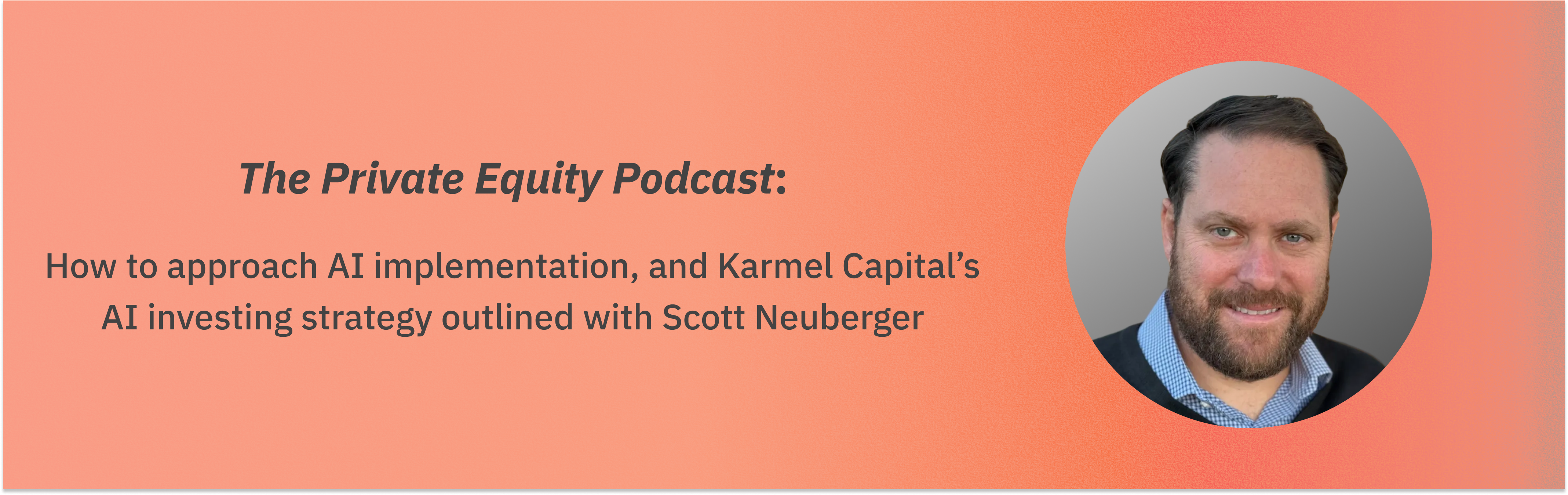
In this episode of The Private Equity Podcast, Scott Neuberger, Co-Founder and Managing Partner of Karmel Capital, breaks down how his firm identifies late-stage software and AI winners using 80+ capital efficiency metrics across 500+ companies. He explains why AI infrastructure offers the best risk-adjusted returns, how Karmel uses AI internally to accelerate data collection and analysis, and where portco leaders should start their AI journey: labor-intensive functions like customer support where ROI is immediate. Watch/Listen here →
AI in private equity is no longer a thesis, but rather an execution game. The firms pulling ahead are deploying at the portfolio level and building the internal muscle to scale what works. As we head into 2026, the question is: will AI be what separates your exits from the $3.7 trillion backlog, or leaves them stuck in it?