Private Equity Edition ·
PE's AI Discipline Era
Private equity's AI story is entering a new chapter.
Private equity's AI story is entering a new chapter.
Hi, I’m Lily. I created this PE edition of the AI Dispatch for our growing community of thousands of private equity leaders and portfolio company operators navigating AI implementation.
This week’s theme: AI's institutional moment in PE.
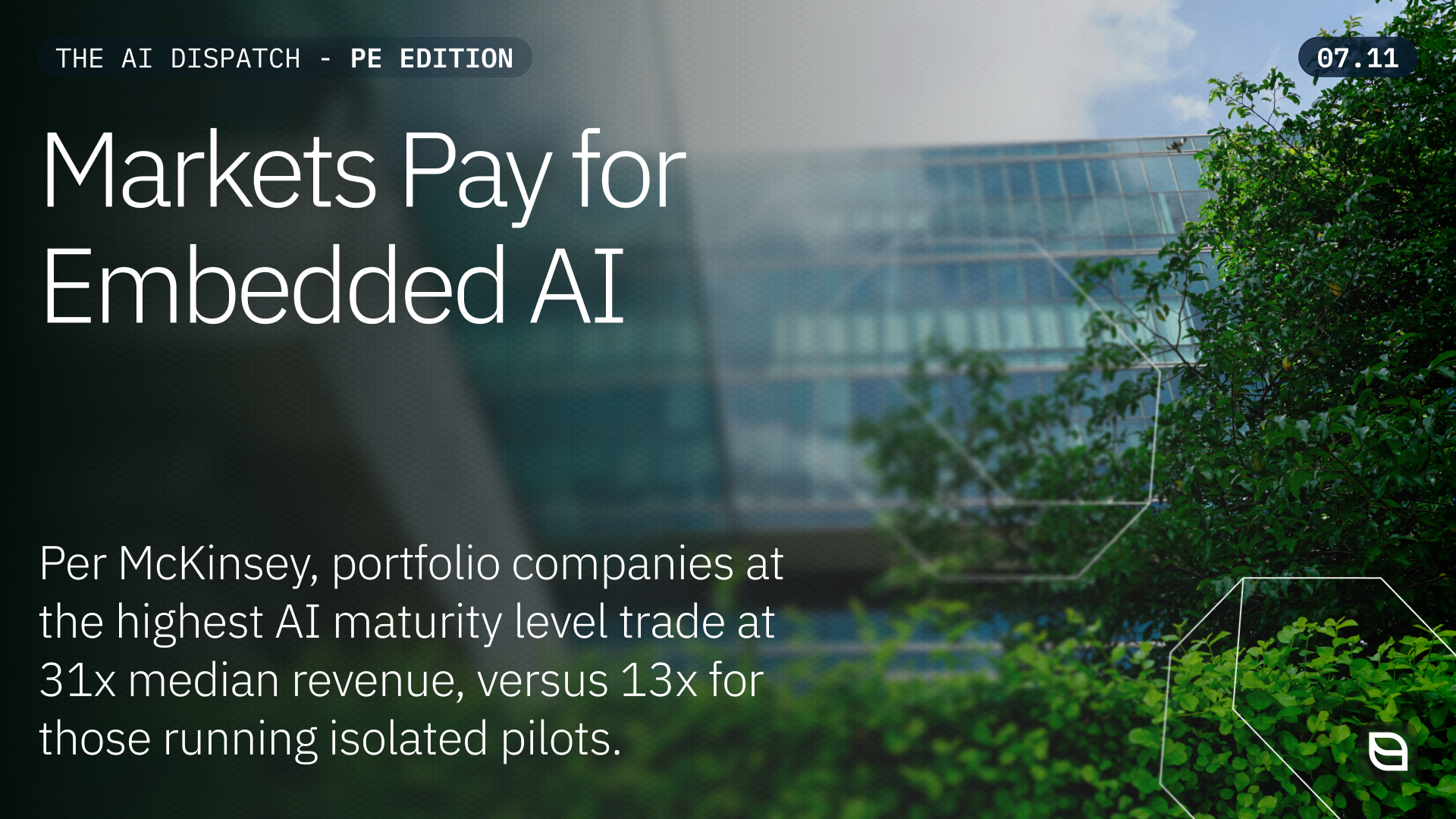
Private equity's AI story is entering a new chapter. After two years of experimentation and scattered deployments, BCG's research on 1,250 companies reveals a sobering truth: 60% have yet to realize measurable AI value, not because the technology doesn't work, but because deploying tools without transforming operations delivers little beyond expensive dashboards.
Now, a disciplined minority is pulling ahead by treating AI as institutional capability rather than innovation theater. This week, we examine what separates the winners from the majority still stuck in pilot purgatory, and why one portfolio company's decision to prove AI ROI internally before evangelizing externally helped it earn a $12.3 billion acquisition.
BCG's study of 1,250 companies confirmed what many PE leaders suspect: roughly 60% have yet to realize measurable AI value, with the majority stuck simply deploying tools without transforming operations. BCG argues PE sponsors must shift focus to Reshape initiatives that redesign core functions like R&D, sales, and customer service to unlock actual P&L impact. BCG's case studies span proven outcomes: 53% cross-sell uplift and 8% ARR growth for a SaaS company, 40-50% faster proposal creation for a logistics firm, and 30% OPEX reduction for an asset manager. BCG stresses that PE firms shouldn’t join the majority that's struggling, but rather learn from the minority that's winning, no matter how tedious this is. Read more →
Following high-profile AI failures like Deloitte Australia's 2025 scandal, PE firms are shifting from hype-driven deployment to disciplined, governance-focused implementation. BCG's survey of 280 finance leaders reveals that high-ROI AI adopters emphasize human judgment and value creation rather than automation for its own sake, with companies measuring human-centric ROI twice as likely to scale AI successfully across teams. McKinsey data reinforces this: firms allocating resources toward long-term value creation outperform on both revenue growth and return on capital versus those chasing short-term savings. The reset is clear: AI's financial upside comes not from automation alone, but from thoughtful integration of human judgment, contextual knowledge, and governance into model design. For PE portfolios, this means abandoning "deploy and hope" toward strategic implementation that combines domain expertise with AI capability. Read more →
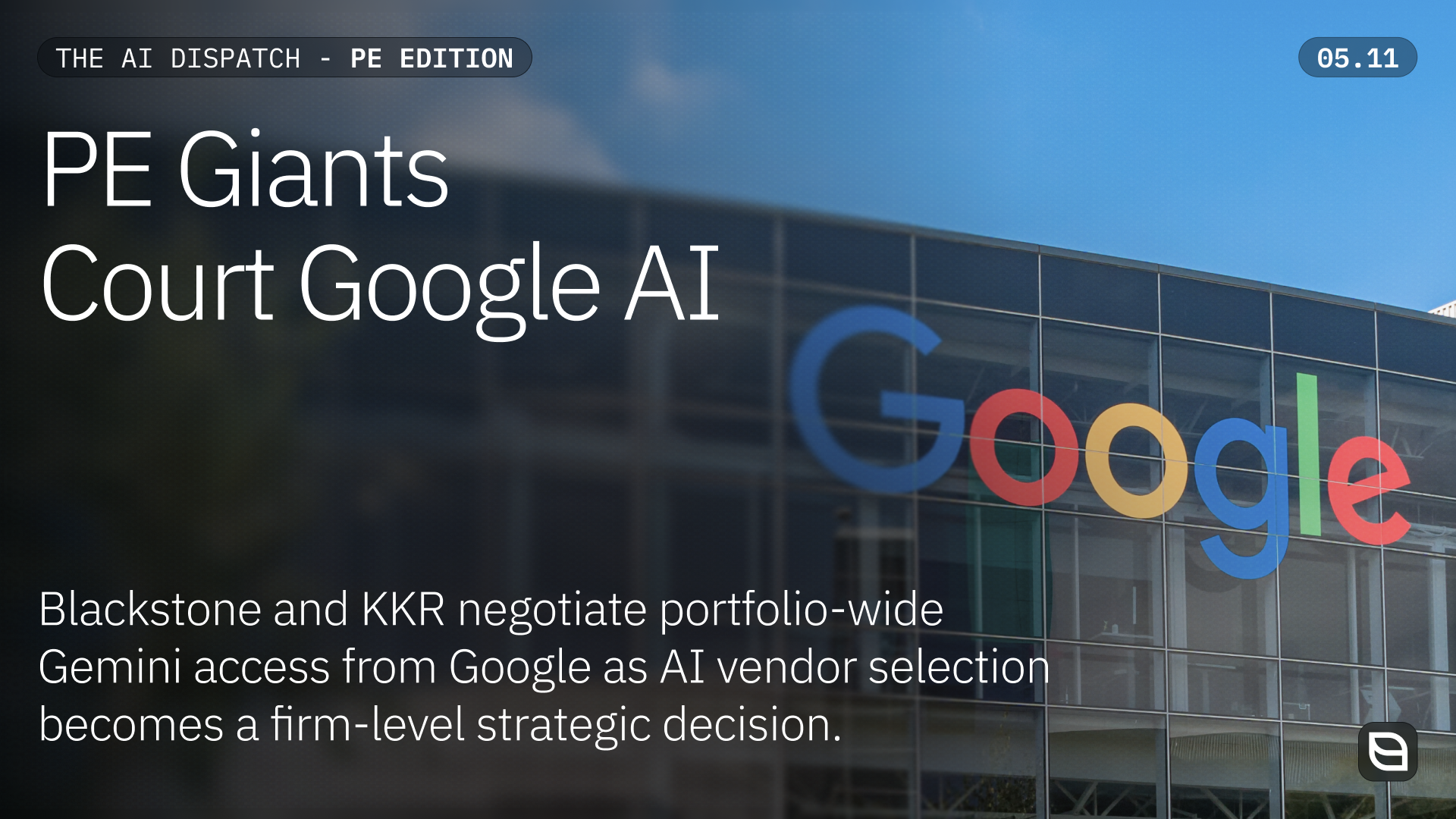
PE funds are shifting from portfolio-company-by-portfolio-company AI experimentation to centralized, fund-level AI coordination in 2026, according to an FTI Consulting industry predictions report showing 65% of PE firms marked AI as a top priority in 2025. The shift is being driven by a harsh realization: financial gains from AI deployments have been "mixed" because tactical, task-level automation doesn't deliver meaningful value without workforce upskilling, adoption management, and operating model redesign around AI-augmented labor. This evolution marks a fundamental change from "let each portco figure it out" to "build institutional AI capability that compounds across the portfolio." Read more →
Every week, we’ll bring you a new, real-world example of how targeted AI deployments within portfolios are solving persistent business challenges.
Company: Dayforce (Thoma Bravo; acquisition announced August 2025, expected to close early 2026), a $1.76 billion HCM software provider serving nearly 7,000 organizations globally.
Problem: Despite selling AI-powered HR software to thousands of companies, Dayforce faced the same operational challenge as its customers: a lean HR team supporting ~10,000 employees worldwide with manual processes. Employee engagement surveys generated thousands of unstructured comments that took over 100 hours to process into actionable insights. Routine HR queries created bottlenecks that eroded employee satisfaction. With 67% of employees lacking AI training yet 63% believing AI is critical to career growth, the company recognized it needed to demonstrate AI’s value internally before evangelizing it externally.
Solution: Dayforce deployed its own AI assistant internally, using the same HCM platform it sells to customers. The AI assistant handles routine HR queries with automatic agent engagement through to approval, while generative AI analyzes employee sentiment from engagement surveys, identifies compensation anomalies during promotion cycles, streamlines recruiting workflows, and accelerates training development.
Results:
Thousands of comments processed and themed in 1 day (previously took weeks or months)
100+ hours saved processing 10,000 engagement survey comments
Time-off requests: 2-3 minutes → 30 seconds (83% reduction)
~70% of complex HR problems resolved by AI assistant before reaching HR team
Annual savings: Hundreds of thousands of dollars through process automation
Thoma Bravo’s $12.3 billion acquisition aimed at accelerating Dayforce’s “AI Leadership in HCM” validates that portfolio companies demonstrating measurable AI ROI in their own operations command premium valuations. Dayforce didn’t just build AI products for customers; it rebuilt internal workflows to prove the thesis.
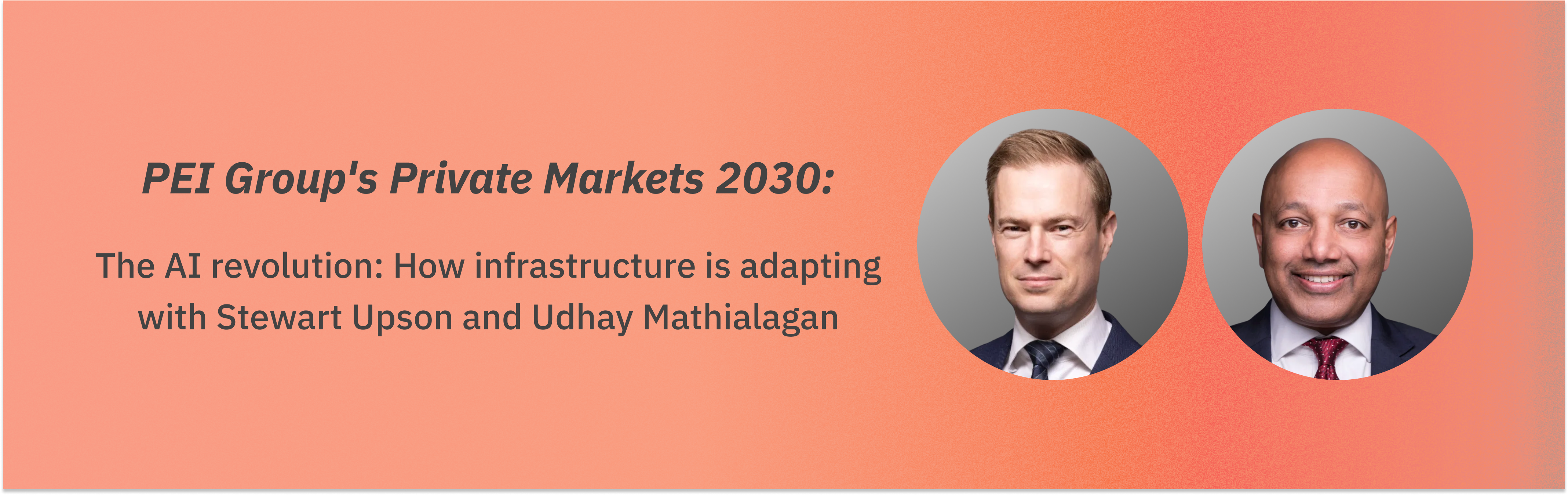
In this episode of PEI Group's Private Markets 2030 programme, Stewart Upson, co-president of Brookfield's infrastructure group, and Udhay Mathialagan, CEO of Brookfield's global data centre practice, discuss how AI's exponential growth is creating one of the decade's most significant infrastructure investment opportunities. The conversation examines the physical reality: AI depends on vast amounts of power generation, transmission networks, advanced data centres, and computing infrastructure that must be built now to meet demand. For PE investors, the episode underscores why AI infrastructure has become a top investment priority in 2026, with capital flowing toward the physical layer that makes AI possible rather than AI applications alone. Listen here →
The Dayforce story reveals what PE operating partners should study closely: rebuilt your own operations first before building AI products to sell. That internal discipline is a lesson in credibility. Portfolio companies that walk the talk, demonstrating measurable ROI in their own operations before evangelizing to customers, command premium valuations. Dayforce understood that AI value creation is about having the discipline to transform your own workflows first, prove the thesis internally, then scale that expertise outward.